Prose

Amor / Addiction

a photograph is all that lasts long

with glory years and quiet fears gone

when summer days are far away

you can dream of skies and lover’s eyes

blue

Shoecraft, Eyes, Blue 

OF all the addictions that may plague a man, an addiction to love is the trickiest addiction to have. This is due to the singular fact that one can not buy love in the marketplace. If one could, that would be another matter entirely and we would not be having this conversation for I would be in the marketplace but we are, and I’m not, for it is — truly, insufferably — priceless.

Its effects are astounding. It can take a boy of fifteen — a promising young lad with a first-rate mind and sound disposition — and render him anaesthetised to worldly pursuits. The worlds of commerce and politics and sport are forever more left grey and drab to him. The gold stars of society no longer mean anything to him. He has glimpsed a world drenched in colour and he can not thrive without it. Over the years, he secretly feeds his addiction with scraps of poetry and ancient Persian treatises on Sufism. He devours literature with an unslakable thirst, searching, ever searching. He sees something he can not articulate in the way the sun sets behind lonely apartment complexes. Something beckons to him on the sea breeze as it blows through banyans in the hot afternoons. And something tightens in his chest every night as he watches the rising of the stars from the roof of his ancestral home. Everything he writes ends the same way: smeared with the half-remembered colours of forgotten love. Like waking from a dream and scrambling to put it all down before it’s lost to the aether; knowing it’s going, knowing it’s gone, knowing even as you begin to write that it’s useless and yet still grasping for another fix, you addict, happy in your addiction, wouldn’t trade it for the world because you’d rather your half-remembered colour than the grey, grey, grey of everyone and everything else…

There is a boy or a girl a thousand years hence on another planet who is reading all this, feeling all this. Here, Earth is merely a byword for an unspeakable nostalgia. I write to you — future-boy, future-girl — from your ancestral home. The colours are real. They exist. There is only one way to find them and there always has been. Good luck. Godspeed.

Standard
Prose

Keenjhar Lake

ZUAtlas's avatarThe Ziauddin University Atlas Blog

Hasham Masood, M.B.B.S., Batch XVIII.jpgGharo, Sindh, Pakistan. PHOTO CREDITS: HASHAM MASOOD, M.B.B.S., BATCH XVIII

BY: SHAHZEB NAJAM, M.B.B.S., BATCH XVIII

If you sail far enough into the blue waters of Keenjhar Lake, you’ll see a small, stone structure rising up out of the waves. You disembark onto weather-beaten steps and climb up to a white, circular platform and in the centre, in eternal solitude, lie the graves of an ancient king and an ancient queen. You say a small prayer for the royal lovers — for all lovers, in all epochs, and for those who loved too much. Before you leave, your gaze lingers a moment longer on the setting sun and the wind-ruffled waters and you wonder why it feels like you’ve left something of yourself behind there with Noori and with Jam Tamachi and their thousand sunsets. Soon, the stars will rise. And I shall think of you.

About the author: Shahzeb…

View original post 18 more words

Standard
Prose

In your most frail gesture

BY: SHAHZEB NAJAM, M.B.B.S., BATCH XVIII I saw a patient today. He had Parkinson’s. Tremors, shuffling gait — the works. His wife was with him. She was old, too. I opened the door and helped him into the room and stood by him to steady him. And then his wife came […]

via  In your most frail gesture — The Ziauddin University Atlas Blog

Standard
Prose

8-bit Philosophy 

Yousuf: “Kya fascination hai 8-bit sé?” (What’s your fascination with 8-bit?)

Shahzéb: “I like 8-bit because 8-bit is to us what we are to God. It’s the closest we can get to touching the mind of the divine. You plug in a game into a beat-up old Nintendo and the little screen lights up with a brand new world of life and light and adventure. And you see a little hero and you watch his little life play out and he evolves over time and, before you know it, you care about the little sprite more than you want to admit. You love him and you root for him and you guide him and you watch him do all the things you can not because you have responsibilities… 8-bit is a distilled essence of our world. It’s forced by the limitations of bits and bytes to build a universe out of a few, small pixels. Like our world — of quantum pixels — built with care and with love and programmed with destiny. But the best part is the feeling you get when you realise how small the 8-bit world is. It has walls. It’s a sandbox that’s too small for all you’ll ever want. And you realise that you feel that here, too. And the 8-bit world is too small because it’s been made by us; us, who’ve seen bigger things. That lingers on in the subconscious of the little sprite-heroes. And it’s the same with us. That’s why we feel a twinge in our hearts every time we look up at the stars. This is why I love 8-bit. Because it reminds me that there is more than… this.”

Yousuf: “Consider teaching philosophy. At least once in your life. And fill it with this stuff. Then write a book. Title it The film of my life.”

Shahzéb: If I do, I’ll call it One Last Sunset.

Standard
Prose

Why I Write

This post was first published here, on the Ziauddin University Atlas Blog.

I REMEMBER the day I decided to become a writer.

It was one of those endless summer Sundays in Karachi and I was bored, bored, bored. The grown-ups were in the den, going on and on about politics and, restless as usual, I headed up the cold marble stairs to my Nani’s library.

The afternoon sun blazed in through the open window and I began to pick and prod at the vast, dusty shelves, looking for something — anything — to pass the never-ending Sunday.

And then I saw it. It was a thin, black volume, and it caught my eye because of how incongruous it looked among a big pile of medical textbooks. I pulled it free and wiped it clean and coughed from the dust.

An alien sun gleamed on an alien beach and that was how I met Arthur C. Clarke and his ‘Songs of Distant Earth’. The name of the book isn’t important. Every writer has their own such book.

What’s important is this: how I didn’t notice the sun sinking below the horizon until it was too dark to read; how I didn’t hear my mother calling to me from downstairs; and how, for weeks, I had dreams about Thalassa and the loneliness of space and the immensity of time. I could never look at the stars the same way again. And I just couldn’t figure out how those static little black words on yellowing paper could do that to a person.

So I decided that there was only one thing to do: become a writer and work that dark magic myself. After all, I figured, how hard could it be? Suffice it to say that my first ‘masterpiece’ was a story called Bus 13 and it was, you guessed it, about a poor old bus that had the distinct misfortune to be haunted. To their credit, my parents never let on how bad it was; they didn’t even laugh at the yellow clip art bus I had pasted at the very top of the page.

But I knew. It was a story, sure, but it wasn’t… that. And I realised then that this wasn’t going to be easy. It wasn’t the words on the page. It was the emotions — the ideas, the heart — behind them. And that needed something more: a sincere curiosity about the world and the people in it; an awareness of your own emotions and the strength to interrogate those emotions at length to figure out why exactly, that particular sunset or song made you feel all weird inside. So this, then, is why I write. To capture those moments before they’re lost forever. And to one day leave behind a thin, black book that, decades from now, some boy or girl will find on a dusty bookshelf one sunny summer afternoon and then, well, nothing will ever be the same again.

About the author: Shahzéb hopes to do his residency under the great Dr. Ernesto Guevara de la Serna. 

Standard
Prose

They have not lit the lamp at the other farm yet / and all at once I feel lonely 

If there is only enough time in the final

minutes of the 20th century for one last dance

I would like to be dancing it slowly with you,

say, in the ballroom of a seaside hotel.

My palm would press into the small of your back

as the past hundred years collapsed into a pile

of mirrors or buttons or frivolous shoes,

just as the floor of the 19th century gave way

and disappeared in a red cloud of brick dust.

There will be no time to order another drink

or worry about what was never said,

not with the orchestra sliding into the sea

and all our attention devoted to humming

whatever it was they were playing.

Billy Collins, Dancing Towards Bethlehem

I WENT to my grandfather’s grave today. It’s high up on the side of a hill and to reach it you drive up through secluded streets shaded by large trees and there, between two houses, is a tiny blink-and-you’ll-miss-it lane. It’s so narrow that even if you’re small, you can reach out really, really far and touch the dusty whitewashed walls on either side. 

As you emerge from the lane you find yourself at the top of a hill, all of Karachi spread out before you; below you grave after grave until your gaze rests at the foot of the hill. That’s a hell of a view, you think, this is a good a place as any to be buried. And imagine what it must look like at night with all those city-lights sparkling under the stars. 

You pass headstones and shaded tombs and carefully step over mounds — some so heartbreakingly small that you don’t want to think. All of them carry a story. 

PROF SURGEON H. M. SIDDIQUI says one. 

EAT WELL, DIE YOUNG, AND HAVE A GOOD LOOKING CORPSE says another. 

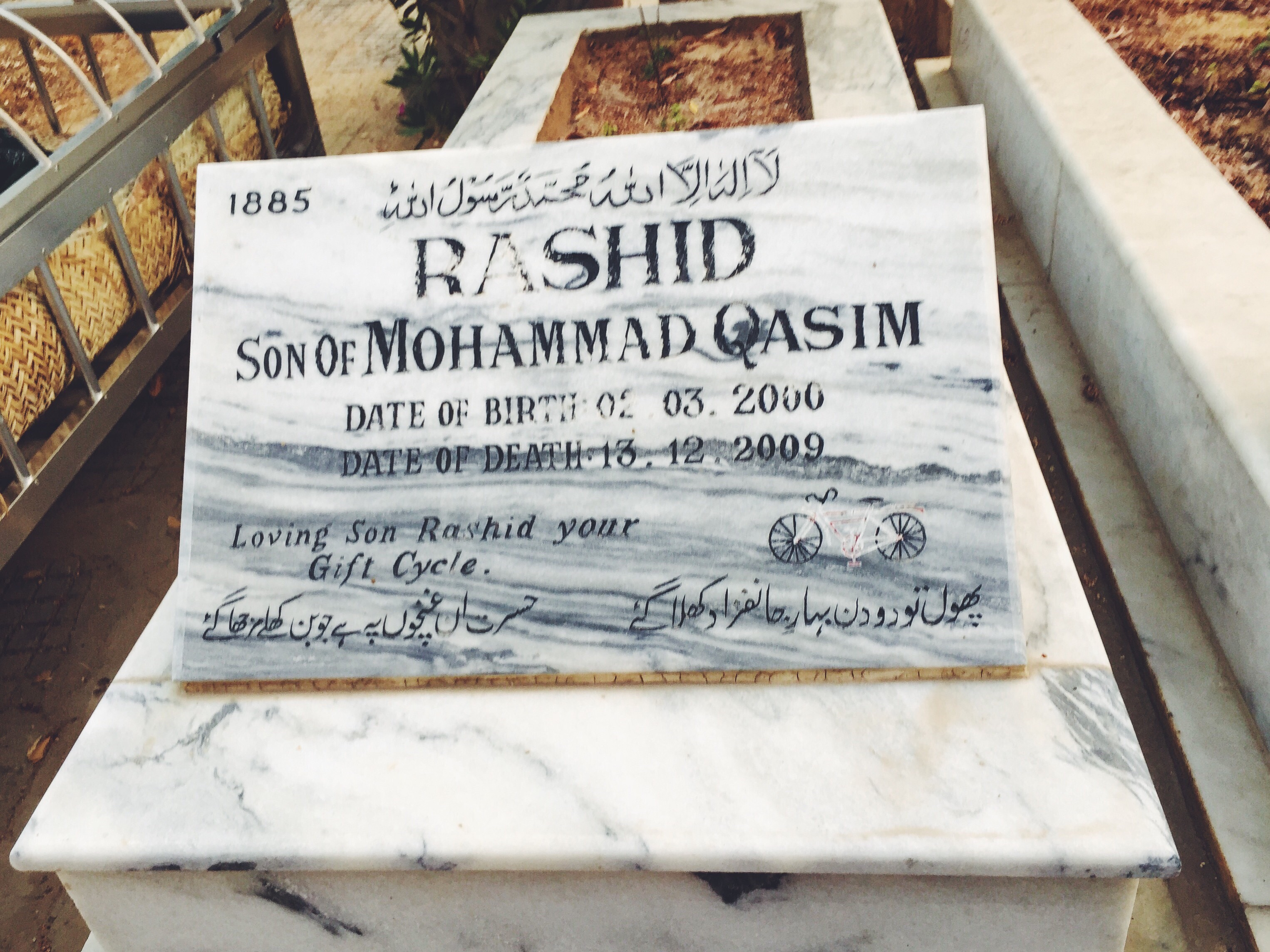
One of the smaller ones has a red bicycle with black handlebars carved carefully into the marble. Underneath, in small, neat letters it says LOVING SON RASHID YOUR GIFT CYCLE. 2000-2009. 

There’s a small staircase that leads down to my Nana’s grave. And there’s a small, white marble bench at the foot of it for visitors. The caretaker comes and washes the grave and then I lay the rose petals on it and say a small prayer. As the caretaker leaves, he tells me how my grandmother came just yesterday. She’s here most days, he says. Sits just there, on the bench, till sunset. He walks away up the staircase. 

And now I have to sit because my vision is blurry and my legs feel strange and I can smell the rose petals on the sea breeze. And I think of her, sitting here all alone, day in day out, even though it’s been three years, sitting on that bench that looks over Karachi and the grave of the man who spent his whole life with her and I wonder at a loneliness I can not begin to imagine. 

At the end of his book Contact, astronomer Carl Sagan writes that for small creatures such as we the infinities of the cosmos are made bearable only through love. We need the enveloping arms of those we love, ready to catch us when we grow dizzy from contemplating eternity. 

And as I lie here on the roof watching Sirius twinkle across the vastness of space and the immensity of time, I realise he knows what the hell he’s talking about. 
  

“The flowers did show us spring for a while / yet I long for the flowers that never bloomed at all.”

— Translation by my old friend, Yousuf Mehmood.

Standard
Prose

The Quiet Saudade of Video Games

A city child, down for the summer.

When suddenly he walked into

the twelve-foot wall of corn.

Leaving the dogs. Firelight

on the barn. The smell of Carolina.

The stars making me lurch.

Thirty years ago…

Jack Gilbert, Another Grandfather

SO THERE’S this game. Firewatch. The game is you by your lonesome in a lookout tower, deep in the woods of some heartland American state. Now just imagine that. The woods stretch away on every side, far as the eye can see. You have your little tower and you watch the sun set and rise and if you listen close you can hear the sound of a stream a little way away and the crickets and birds chirping in the forest. Your walkie-talkie buzzes every once in a while and you can talk or not talk and it just adds to the solitude like hearing a piano note hesitant in the dark, late into the night. I don’t know. The idea of that. There’s something to it. To these games that speak of solitude and the quiet exploration of weathered lighthouses on windswept islands (The Sailor’s Dream) or haunting backcountry woods (Firewatch) or even a vast, lonely universe and you in your little spaceship, alone amidst the stars (No Man’s Sky). It’s like they’re a Sufi journey into one of Attar’s seven valleys.

A while back there was this movie about a guy who’s a 9/11 survivor and he’s got PTSD and to cope he plays Shadow of the Colossus, a game where there’s just you and your faithful horse and the deserted ruins of an ancient Babylon.

Then there was Far Cry 4 and, don’t get me wrong, it was nice and all hearing Urdu gaalis in a video game but the best bit is making your way up the Himalayas and pushing through the snow covered trees until you spy the little stone path cut into the the mountain that leads up, higher, higher, and you follow it and it opens onto a little terrace on the side of the great mountains and a small sign by the path says it’s your ancestral homestead and there’s a little wooden house and a well and some goats and a small garden that ends at the edge of a steep drop and you stand there, all of Kyrat spread out before you. It’s home, you know?

Even No Man’s Sky is an aspirin for when you’re star-drunk from staring at the night sky too long and can’t breathe because there’s not much time left and there’s a universe to explore and you don’t have a starship by your side and you never will and you realise, then, that it’s taken so long for the light to reach you from those stars that they’re probably dead and buried on those alien, alien worlds and all you can do now is watch them and realise that that’s why they say ‘a long time ago in a galaxy far, far away’…

I’ll probably never play all these games anyway and I guess that’s for the best. This way I’m free to project my own saudade onto them. Truth is, they’d never be as good as my dreams.

Standard
Prose

A Light Between Oceans

Also published on the Ziauddin University Atlas Blog.

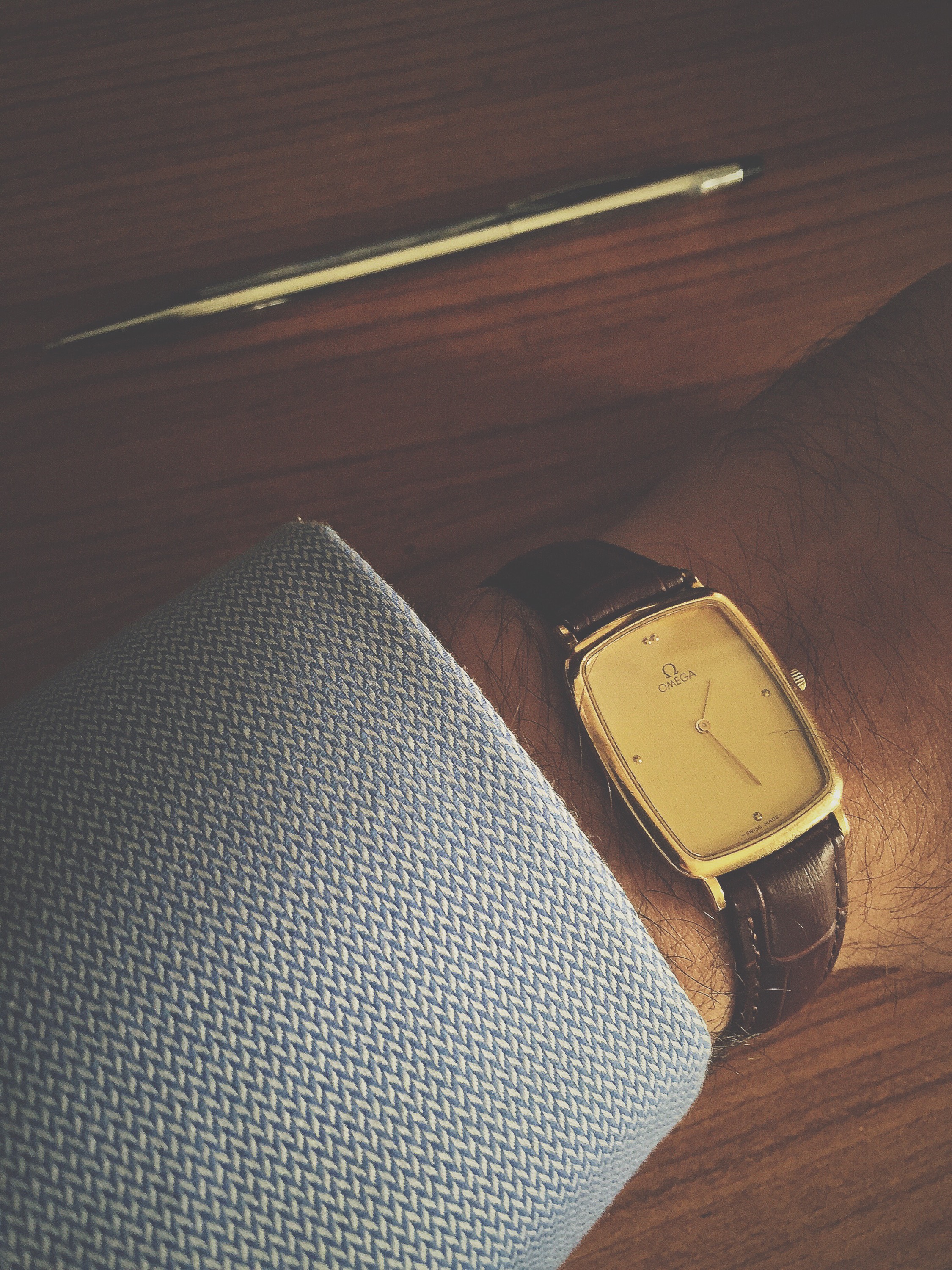
MANY years ago my grandfather gave my father a watch and my father gave it to me. It’s an old Omega De Ville — soft, brushed gold that catches the light just so on those long summer Sundays in Karachi. 

Watches are strange beasts: precious metals forged in the fiery cores of supernovae, held in place by delicate strips of perishable leather; keeping time to the warmth of other suns. 

If built true and kept well, the metal soul of a watch will outlast the wearer and be passed on with a bit of history and a patina of character. But the leather will not last. Sweat and rain and time will break it down, eventually.

A word on time —

I’ll tell thee everything I can:

There’s little to relate.

I saw an aged aged man,

A-sitting on a gate.

The aged, aged man is Kronos, God of Time. Chronology and chronographs are Chinese whispers of his name. But his kingdom can not lay claim to all of time. Quantitative time is his province, the one that my old Omega ticks off the seconds to. And while it’s a vast, powerful state, its smaller neighbour is just as essential to temporality. 

One of the disadvantages of living in this city by the sea is the havoc wrought by humidity. Leather straps rarely last more than a few years. The last one was a rich, dark brown with a word embossed on the reverse in small, block letters: K A I R O S. Kairos, the God of qualitative time. 

So while Kronos charts out the maps which underlie our lives — from the alarm-clock that wakes us from the wistful nostalgia of our dreams, to the calendars that lay out our days of work and leisure, leisure and work — Kairos marks out our lives themselves — the sunset conversations with old friends that end far too soon; the endless years spent in a half-hour noon nap’s dreamworlds.

Kronos with his time and Kairos with his timing. And in between these two oceans stand the lighthouses of our lives, lights aimed first at one, then the other, forever afraid of committing fully to either. 

And perhaps that’s best. For without the strap or without the metal, the watch is incomplete. But put them together and you have a marvel of ingenuity and engineering that proclaims the passage of Time — and also the subtler passing of the times

And as one generation passes on its wisdom to the next, we are, before we know it, adrift between the gods.
  

Standard
Prose

Babylon

next door
the lovemaking
subsides
stars fall
from other worlds

Micheal Windsor McClintock

THERE was the time I found that old laptop in the attic and I asked and I asked but no one knew where it came from. It was dusty and slow — Windows 95 and all that — and inside were stories written by a sixteen-year-old girl called Elizabeth.

The stories were about heartache.
The stories were about young love.
The stories were about moving to New York and being an artist and living in a small apartment that looks over Central Park, watching the sun set on another day and you; you that much closer to the truth.

It was the sort of stuff young girls called Elizabeth write about.

They were not particularly well written.
They weren’t Hemingway.
They weren’t Márquez.
They certainly weren’t Jack Gilbert.
But they were unfinished.

I spent long summer nights dreaming about those stories. And I searched and I searched but I never could find her — there are a lot of Elizabeths in the world.

So I did what anyone else would do: I began to write.

I wrote to fill the emptiness left by those long forgotten stories written by a young girl in a small town called Babylon; waiting to grow up, waiting to find home.

Processed with VSCOcam with p5 preset

Standard
Prose

Eternal Summer (or HOPC)

One who has lived many years in a city, so soon as he goes to sleep,

Beholds another city full of good and evil, and his own city vanishes from his mind.

He does not say to himself, “This is a new city: I am a stranger here” ;

Nay, he thinks he has always lived in this city and was born and bred in it.

What wonder, then, if the soul does not remember her ancient abode and birth-place,

Since she is wrapt in the slumber of this world, like a star covered by clouds?—

Especially as she has trodden so many cities and the dust that darkens her vision is not yet swept away.

Rūmī 

SOMETHING’S broke, doc. Something’s broke. You gotta help me. It’s broke inside and I — I just can’t fix it. I had this dream, see? Well, it wasn’t a dream dream. Like I was asleep, sure, but it was real too, you know?

I seen this place, doc. This big ol’ school field. Biggest field you ever seen. And me? I’m standing by the edge of it watching these kids play in the field. They’re kicking around this old football and one of ’em, he sees me, and he’s waving across that big ol’ field.

“Come on!” he’s saying, “whatcha waiting for?”

And I look closer and it’s the guys, doc! It’s the guys! I ain’t seen them in years! So I run over to ’em and we play and we play and we play. We play until the sun’s low in the sky and it hurts my eyes just to look at it.

And then? Then we just sit there in that big ol’ field, catching our breaths, watching the sun set on another summer’s day. Summer ends way too soon, huh doc?

Now in the dream I start to feel thirsty, see? So I tell the guys I’ll be right back. The school’s right there — just up ahead — and I walk to the courtyard, all the way to the water fountain. The water tastes a little funny, yeah, but it’s alright. It’s pretty cold.

It’s all a bit spooky though, you know? School’s are always spooky at that hour. I mean, just think about it, doc! Think about all those empty classrooms, all those empty desks and chairs facing empty blackboards all night long. It’s spooky!

So I wanna get the heck out of there as fast as I can. I drink that water, doc, eyes closed, trying not to think of what’s in them empty classrooms. And then I feel cold, doc. All of a sudden, I feel cold. I look up and the sun’s setting and it’s almost set so I turn and I run back towards the field. But when I make it out of there, the field’s empty and the sun’s set and it’s all grey, doc. It’s all grey.

I wake up, then, and I’m covered in a cold sweat but it’s just a dream, right? So I turn over and I go back to sleep. In the morning I wake up and I remember and it’s spooky and all but it’s just a dream, right? So I head to the shower. But I can’t tell the hot water tap from the cold water tap. They’re both grey!

It’s been a week and it’s all grey now, doc. You and your desk and the light from that window and the city outside that window. It’s all grey now. It’s all grey. I don’t wanna live in the grey, doc. You gotta help me! You got a pill or something? I never been on any pills, doc, but I’d take ’em just to see the colours again.

Colour’s grand, doc, ain’t it? It’s like summer, doc. And this grey? Well, I been shivering in it for too long now.

You gotta help me, doc. You can fix it, can’t you? Fix what’s broke inside? I sure hope you can, doc, cause by god I’m sick—’n—tired of it. I ain’t crazy, doc. I ain’t. I been going to work and I been going to church and I been eating my vegetables. I even laid off the smokes, honest doc!

But it’s just so grey. I can’t take it anymore. I miss the colours, you know?

I miss not being broke inside.

IMG_0557

Standard