Prose

Iskandar’s Stars

Days I have held,

Days I have lost…

Derek Walcott, Midsummer, Tobago

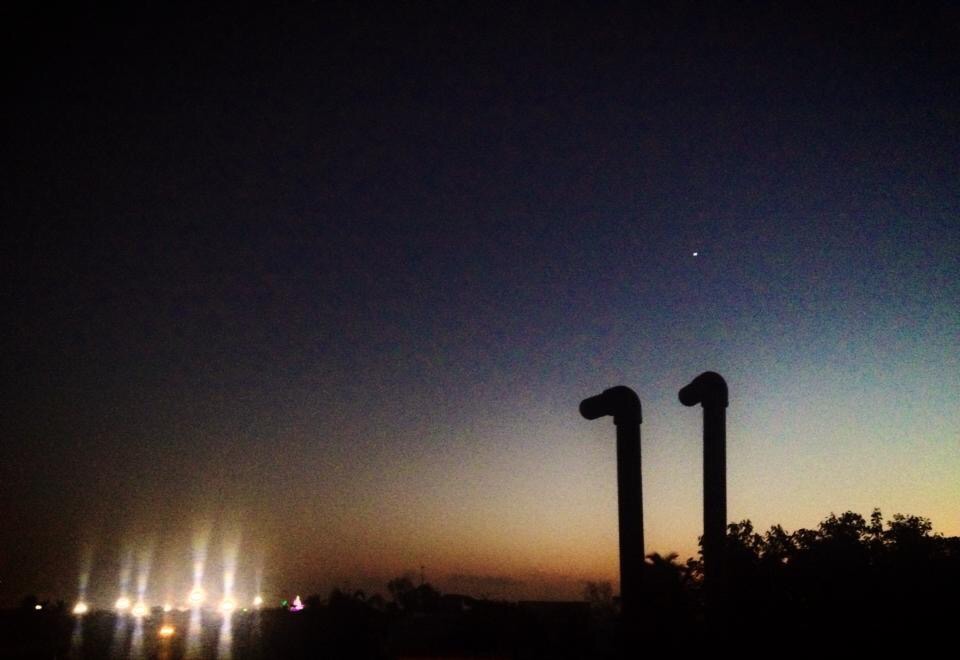
ISKANDAR sipped at the warm coffee. The dim lights of the bridge bathed his blue uniform in a soft glow. He sat before the vast view screen and contemplated the sprawl of stars spread out before him. He listened to the quiet hum of the ship’s engines and took another sip of the coffee and closed his weary eyes.

Sir?”

“Hmm?”

“Sir, shouldn’t you be asleep?” Iskandar half turned and raised an eyebrow at the silhouette that framed the doorway. He watched as she walked past the sleek consoles with their darkened screens and took a seat beside him. She reached for his coffee, plucked it out of his grip and took a long, long gulp.

“There isn’t any sugar,” she said. Iskandar grunted and turned back to the view screen.

“Iskandar,” she said. “It’s October.”

“I know.”

“No,” she said. “You don’t know. It’s October and the crisp wind from the desert is just beginning to blow across Karachi and the nights are cold and crisp and dusty but the dust doesn’t block out the stars and you can see Rigel and Arcturus and Capella from the roof of your parents’ house and we could huddle up in a blanket just like we used to and watch the lights on the Ferris wheel at Hill Park fade into the night and we’d have warm cups of coffee with lots and lots of sugar and — ”

Enough, Zara!” His fist hit the top of the desk beside them and the thud ricocheted through the empty bridge. She met his stare coolly and he found that he could not hold her gaze. They sat like that for a while and then Zara stood up and made for the door.

“Wait. Please.” She stopped but didn’t turn around. He moved towards her and touched her shoulder and she trembled and turned away. He reached for her hand and their fingers intertwined. She turned, then, and looked up at him and he saw tears glittering in her dark eyes and cursed himself. He whispered apologies in her curly locks and she wrapped her arms around his neck and pulled him down and he kissed her soft and deep just like the first time in that lonely football field behind the old school as Sol set on another day in the city by the sea.

“I’m sorry.”

“No, I’m sorry.”

He held her close and they walked like that, arms intertwined, back to the view screen and they sat like that, arms intertwined, before the infinite array of constellations.

“You don’t have to do this. You’ve done enough. You’ve done more than any of them.”

“I have done nothing.” He was quiet, but firm. “A universe lies before me, Zara. Destiny lies before me. How can you not understand? How can you not understand?”

Zara pursed her lips.

“Iskandar, do you know how the ancient Greeks saw time?”

“How?”

“They saw the future as something that came upon them from behind as they stood watching the past recede before them.”

“I do not understand.”

Think, Iskandar. One day you and I will die. You will lie there, watching your past recede before you. Is this what you want? Is this the past you wish to look upon?”

“Zara, there is nothing for me there. They are dogs who tear at each other for scraps and whether we return or not, they shall always be dogs.”

She pulled away and said nothing and his voice softened and he reached for her hand.

“Listen. Listen to me. Don’t you remember when we were kids? Don’t you remember how we’d sit on the dusty roof of your apartment and watch the rockets from Port Qasim lift off at dusk. They were leaving behind the grime and the grit of Karachi for new vistas. They were leaving it behind for adventure, Zara. For glory.”

“And can’t you remember college? Can’t you remember how we fought for freedom against that bitch of a government? You’re the one who led the fight, Iskandar. And when they locked you up — ” She bit back a sob and he moved to close the distance between them but she held out a hand.

“No, listen. I’m fine. Listen. You led the fight and they locked you up but we did it. We broke them. Together.”

“I remember,” he said. “I could hear the crowds from my cell.”

“You’re a hero, Iskandar. And now they need us at home.”

“But Zara what shall we do, then? We go back and we fight and we win — it’s just a matter of time until they do it again. It’s a cycle. It’s history. But there,” he pointed to the stars, “there is hope for a new world.”

“And what sort of world shall that be if it’s built on this — on us running from our colleagues, our friends, our families? On us running from home?”

“So you will not come with me?”

She smiled at him sadly.

“You idiot,” she pointed at the badge that glinted on her uniform. “I’m your lieutenant. And your wife. I’ll go wherever you go. I just don’t want you to make a decision you’ll regret. I’ll be waiting for your announcement, sir.” She mock saluted him and he shook his head and smiled as she left the bridge.

Iskandar closed his eyes. He fell into a fitful sleep and dreamt that he stood in a shallow river on the dark plains of the Punjab at the dawn of civilization and in the dark before him stood mighty war elephants and in the dark behind him stood the fractious tribes of his motherland. And, as he watched, the rains of time poured forth and the river began to swell until it reached his knee and then his waist and then his chest and mighty Iskandar, lord of the known world, closed his eyes and dived into the water and firmly struck out towards one of the banks.
IMG_3978.JPG

Standard
Prose

Ad Astra

This is thy hour O Soul, thy free flight into the wordless,

Away from books, away from art, the day erased, the lesson done,

Thee fully formed emerging, silent, gazing, pondering the themes thou lovest best,

Night, sleep, death and the stars.

Walt Whitman, A Clear Midnight

DAWN.

They lower the white shroud into the earth. You watch them. Your hand grasps a fistful of sand and throws it onto the white marble slab. Half-remembered words from a half-remembered religion form on your lips. You throw another handful and step back; then remember the admonitions of your grandmother – odd numbers and monotheism – and reach for some more to make it an even three.
Farewell, old friend.

***

DUSK.

“Where are you going?”

“Up.”

“Why? Don’t go. Come back to bed. Where are you going?”

“Up.”

“What’s wrong?”

“I don’t know.”

“Aw, poor baby. Do you miss him? You must miss him so.”

“Don’t. I don’t know. Don’t let’s not talk about it.”

“Come back to bed. I’ll get your mind off it. Promise.”

“I’m sorry. I can’t. I have to go.”

***

NIGHT.

The roof’s concrete floor is cool beneath your feet. It is dusty. You do not care. In the distance, you see the Friday night lights of a rusty amusement park. You lean against the stone banister and take a swig from the flask. The warmth does much to fortify you against the cold. You watch them until they are switched off. The layers of dust leave a long, white mark on your jeans as you clamber up to the top of the old water tank. You do not care. You lie down and dust off your hands and cross them behind your head. Above you — far, far away — ancient lights from ancient stars twinkle across the inky sky. You watch them. When you were young, your grandmother sung you old Sufi songs. You remember one now:

If the stars in the sky
Should ever burn out

And the nights be left
Cold and distant;

How — pray tell —
Yes, how — do tell —

Should a man discover
His Belov’d?

***

Standard
Prose

Winter Begins in Karachi, PK

And here the paths, made or yet unmade, that told of the need of boys travelling, always travelling, to be men.

Ray Bradbury, Dandelion Wine

THERE were four of us that night. There were usually two and there were sometimes three but that night there were four of us so we all pitched in for a Murree whiskey and a rickshaw to get the Murree whiskey and a hundred rupees more to pay the police, but the police didn’t stop us that night so we got some crisps and some plastic cups and two cold cans of Coke instead. It was a cold, crisp night. Winter drowned autumn in the Indus early that year and by then autumn had crossed the delta and was far out in the waters of the Arabian Sea before anyone could buy a jacket or a scarf or a pair of those thick, woollen socks that itch like hell.

It was Shayan’s idea to break into school.

“Guys, let’s break into school,” he said.

“Okay,” I said, turning to the rickshaw driver, “turn that way.”

“Okay,” said the rickshaw driver. He turned that way.

“Are you both mad?” asked Yasir.

“Shut up, Yasir,” said Shams.

“Shut up, Yasir,” said Shayan.

“Now turn there,” I told the rickshaw driver.

“Okay,” said the rickshaw driver. He turned there.

“You’re all mad,” said Yasir.

Shams punched him once, hard, on the shoulder.

Ouch!” said Yasir.

Stop!” I said to the rickshaw driver. He stopped.

We clambered out and I fished a grubby note from the back pocket of my bluejeans and gave it him.

“Thank you,” he said.

“Thank you,” I said. The rickshaw sputtered off down the darkened alley and we stood there with our paper bags and plastic cups and our two cold cans of Coke and considered the dark gate that loomed before us.

“I know a way in,” said Shams and he marched off, knowingly. We followed him. He had a big brother who knew things and he led us all the way around the school to the back. He pointed at a section where the barbed wire had fallen off but he needn’t have; Shayan and I were already making for it.

“Guys, this is a bad idea!” said Yasir.

“Shut up, Yasir,” said Shayan.

“Shut up, Yasir,” I said.

“Would you like another punch?” offered Shams. Yasir declined.

Shams went first and we passed the paper bag to him and he jumped down the other side and whistled the old all-clear and we followed — first Shayan, then me, then Yasir who sat right at the edge of the wall and stared down at us until Shams pulled at the cuff of his pants and he tumbled onto the dirt floor below.

We were at the edge of the overgrown soccer field that stretched behind the school and we walked to the black-and-white striped goalpost and sat by it. The school was shrouded in darkness but we could see a lonely light in a room at the top of the east wing.

“Maqbool bhai’s room,” I pointed.

“He’s probably asleep,” said Shayan.

“What if he isn’t?” asked Yasir.

“Then we’ll have to share the whiskey with him,” said Shams.

The whiskey was good. We talked about the old days. Shayan talked about the time we’d tricked a mugger into sharing a cigarette with us so he wouldn’t mug us. I talked about the time that pack of feral dogs chased us out of the haunted house. Yasir talked about the summer we finally climbed Kidney Hill. Shams talked about the summer we finally climbed Kidney Hill and then stole Yasir’s left shoe and only gave it back once we were half way down. It was very good whiskey.

“Guys,” I said. “I read something today. It’s a poem by this guy called James Arlington Wright — ”

Arlington?” said Yasir.

“Shut up, Yasir,” said Shayan.

“Shut up, Yasir,” said Shams.

“Yes,” I said. “Arlington. Do you guys want to hear it?” They did. I pulled out a crumbled piece of paper and smoothed it down on my thigh and cleared my throat.

“In the Shreve High football stadium,” I began, squinting in the faint glow from the street light, “In the Shreve High football stadium, / I think of Polacks nursing long beers in Tiltonsville, / And gray faces of Negroes in the blast furnace at Benwood, / And the ruptured night watchman of Wheeling Steel, / Dreaming of heroes.”

I sneaked a glance at them, then, and they all sat with their hands wrapped round their knees so I went on.

“All the proud fathers are ashamed to go home, / Their women cluck like starved pullets, / Dying for love. / Therefore, / Their sons grow suicidally beautiful / At the beginning of October, / And gallop terribly against each other’s bodies.”

No one said a word. After a while, I scrunched the scrap of paper back into my bluejeans and lay back with my head on Shayan’s shin and the others lay back too and we lay there like that, the four of us, and watched the stars shine above the school that night as another winter began in Karachi.

1505201_10151782903162703_1943236974_n

Standard
Prose

Ascension

I kneel in the nights
Before tigers that will not let me be;

What you were
Will not happen again.

The tigers have found me:
And I do not care.

Charles Bukowski, For Jane

WHEN I was younger and religion was more than a word, I would take long walks while they slept, hoping to find something they’d never see. Night after night, I’d stalk the streets in search of something more—past dingy alleys with rabid dogs; past old men whispering sun-kissed songs; past small, warm houses with doors shut tight, a wisp of smoke curling into the darkling sky. And as dawn would break and the world awaken, I would trudge home tired and sleepy and a little broken.

This went on for a while until it seemed that there was nothing left to break and that final night even the dogs gave up their growling out of pity, for what is more pathetic than the one who has lost his beloved? Cold, hungry and a little soul sick, I vowed that that night would be the last and that my journey would finally end, one way or another. I slid a hand into my pocket until it touched steel and, thus resolved, set off towards the bay.

The night was bitterly cold and the desolate stretch of beach held no redemption. The fishermen’s favela was silent and the only lights were at the whorehouse in the distance. I looked out at the taunting waves. The dark waters had no metaphors to offer. A drunk stumbled out of the brothel and collapsed on the sand. I stared at him for a long, long while. Then, without looking back, I ran.

***

THE old city. I doubled over to catch my breath and coughed twice, sweat dripping onto the cobblestone streets. The revolver dug into my side. This is a good a place as any.

“Are you lost, my son?”

I looked up. Something moved in one of the dark recesses. An old man shuffled out, wearing the garb of a Sufi.

“I am not lost. I am tired.”

“Tired?”

“Yes.”

“Ah, I see.”

“I don’t think you do, baba.”

“I see that there is much sadness in your eyes.”

“You are a man of God. I do not wish to blasphemy before you.”

“Have you heard of Hallaj?”

“Of course.”

“Then speak your mind with ease, and do not use that word ‘blasphemy’ again. It is a word of the ignorant.”

***

And so it was that a Sinner found God in the dust of an ancient city by the sea.

20131016-010019 am.jpg

Standard
Prose

Life is a Caravanserai

Think, in this batter’d Caravanserai

Whose Doorways are alternate Night and Day,

How Sultán after Sultán with his Pomp

Abode his Hour or two, and went his way.

Omar KhayyámThe Rubaiyat of Omar Khayyám

ONCE upon a time, there was a great empire. The empire was so vast that its ends were shrouded in mystery and barbarian lands clung to its edges like rotting vestiges. Sometimes, a few armed bands would venture near the borders — like unruly children — craving acknowledgement. But for the most part, the empire lived in peace and harmony.

Now, there was a righteous king who ruled this land and one day he decreed that a great road was to be built from one end of the empire to the other. Since the land was as wealthy as it was large, this presented no great fiscal challenge, merely a logistical one. Soon, the dedicated — though rusty — bureaucracy creaked into action and, reluctantly, the first stones were laid.

Many moons waxed and waned before the final stones were — equally reluctantly — placed, but the job was done and the great black road stood resplendent as a testament to the magnificence of the empire.

The king, however, saw that though the road had made trade infinitely easier, there was still one problem left to tackle. The poorer merchants couldn’t afford to travel, not because the road was taxed but because the cost of the journey included food and lodging. The king was a good man and so he decided that the funds of the state would be best applied to easing the difficulties of his subjects, in the hopes that they would adore him, instead of merely being indifferent. Consequently, the first inns were constructed; a hard day’s journey from each other by the side of that great road.

Now, finally, the bureaucrats had done something truly marvellous. These inns, or caravanserais, were nothing like the crowded, claustrophobic cities that dotted the landscape, rife with crime. No, these were small and warm and safe, filled with the promise of good food, good wine and a soft bed under the stars.

As evening approached and the ancient fires of the sun cooled, the weary traveller would see the caravanserai beckon to him, like a gentle mistress, whispering of sleep and sustenance. And as he lay down, gazing up at the stars, he would ponder on the swirl of milk spilled by a divine hand, carving a path across the night sky. Did he look at that far, far older road and wonder where it began, where it led and who had traversed its many paths, planets and mysteries? Or did his weary eyes wander, just before sleep overtook them, to the far end of the caravanserai and the battered doorway of Tomorrow?

Standard
Poetry

Home

Home

A big, black sea
A small, lonely lantern
On a small, lonely boat
In the big, black sea
And it’s

Home

Far away
Across the fields
A warm little cabin
And
As rain
Lashes;
As wind
Howls;
Outside
Inside, it’s

Home

An urban jungle
Claustrophobic concrete
Soullessness is
Contagious
But:
A roof
A star
A cigarette
Twinkling escape
And it’s

Home

20120401-081410 PM.jpg

Standard
Prose

City of Blinding Lights

THE STARSHIP Magellan was an oasis of existence in an ocean of nothingness. It screamed its loneliness through the inky blackness of space, crying out to the cold, distant stars.

The Captain stood on the bridge, gazing out at the blue speck that beckoned like an old, faithful friend. Thirty years of deep space exploration had taken their toll on him. He was no longer a young man and his greying temples and salt-and-pepper beard made sure he didn’t forget that. He focused on the distant speck again and forced his turbid thoughts to settle. And his mind moved upon silence.

And the Magellan rushed onward to Earth. Too long had it been in the empty voids of eternal night. It craved the noise of humanity, the sweet sad songs of Earth: the crackle of a small, warm fire deep inside a distant forest; the incessant hum of pulsing, breathing cities; the wind forever whistling across desolate deserts of Artic ice; all this and more, it craved, like a moth craves the flame. And onward it ploughed, delirious with thoughts of union, ignoring the ominous premonitions that seemed to almost weigh down its sleek silver exterior.

And as the blue planet drew close enough to fill the Captain’s viewport, a shudder of horror ran through him and the crew that crowded around behind him. For the Earth was dark. Not the quiet, gentle dark of a new moon but the harsh darkness of life terribly extinguished. For none of the great cities of Earth were lit up. And the silence that greeted the navigators was the same silence they had lived with for thirty years; they knew it all too well.

And the Magellan cried out in anguish and frustration and its cries were heard by the cold, distant stars, and the cold, dark planet and it sobbed quietly as the infinite loneliness of space silently closed in upon it.

Inspired by the greatest short story ever written, Arthur C. Clarke’s Songs of Distant Earth.

Standard