Poetry

Moonsmile

Coffee and cigarettes,
Sufis and saudade:
A moment — or two —
Just one moment — just two —
Snatched greedily from
The dark.

Winter and whiskey,
Andromeda and Orion:
There are ghosts that haunt
My old, old house;
And there are ghosts that haunt
My heart.

Watch the stars and sunsets.
Watch the hourglass recede.
‘May you live and love’,
Said he.
‘Mayflies!’,
Said he.

‘May you live’,
Said he.
‘May you love’,
Said he.
And I did.
I did.

20140216-124410 am.jpg

Standard
Prose

A Quoi Bon Dire

Your hair is winter fire

January embers

My heart burns there, too.

Stephen King, It

AS the night deepened on a chilly October’s end, a tired labourer walked by the old school and heard music sweeter than sound. But he dared not stop, nor look back, for he remembered well his grandmother’s voice and he remembered well the stories it held of the djinn that haunt desolate wastes and desolate hearts. But if he had pushed open the rusty, wrought-iron gate and walked through the tall grass of the schoolyard – and if he had made his way up the creaking stairs, all the while following that strange, sweet sound – he would have found himself before a wood-and-glass door, caked with grime. And if he had wiped away the dust and looked in, he’d have seen something remarkable. For within that old classroom, at the top of that old school, someone had broken the monotonous pattern of desk and chair and fashioned them into a circle. And within that strange circle, if you look close enough, you’ll see two moonbeams flickering forever in a dance to the music of memory.

***

Inspired, in part, by Stephen King’s short story, ‘Willa’.

Standard
Prose

Goodbye Milky Way

Published in the first edition of the Ziauddin University Atlas, 2016. 

So much depends
On the condensation in the eyes of a lover
The trembling fault
In the silent breath before a kiss

Unintentional ends
Laced in songs of forever
A hesitant thought
Flickering before a superficial wish

Sahr Jalil

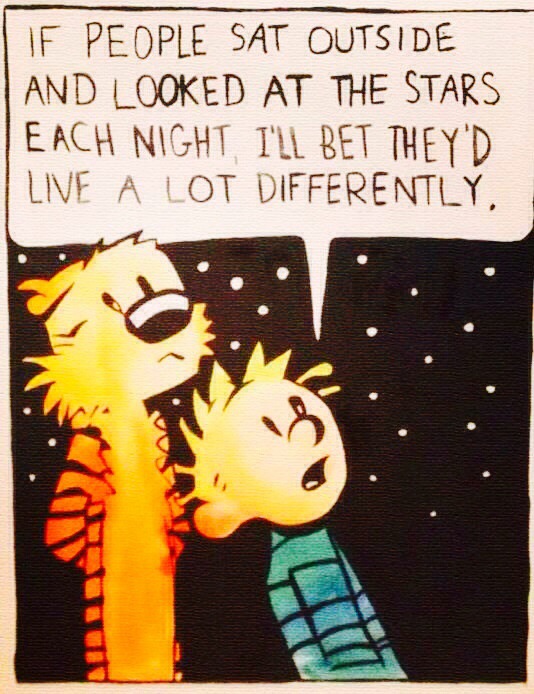
“TELL me a story,” she said, snuggling up to him as they watched Rigel and Betelgeuse twinkle overhead.

“Alright,” he agreed. “But just one, okay?”

She said nothing but he felt her smile in the dark beside him and he was glad.

“Once upon a time,” he began, “there was a beautiful girl who – ”

“Why do all your stories have beautiful girls in them?”

“Maybe because I haven’t found one yet,” he teased.

She elbowed him feebly and he laughed.

“Fine,” she said. But he knew she wasn’t angry. “Go on.”

“Okay, so once upon a time there was a beautiful girl,” he paused, meaningfully, “who danced.”

“She danced so well that all who watched her were mesmerised into silence. And it was not uncommon to see tears glistening on the cheeks of her audience, for in her graceful movement they saw the fragility of life and the transience of existence.

“Now there was a benevolent prince who lived in a castle not too far away and when he heard about this extraordinary dancing girl, he was exceedingly anxious to see her for himself. So he dressed up in the garb of a wandering mystic and set off to satisfy his curiosity. He travelled for many days – he was a benevolent prince after all, not a benevolent navigator – but eventually succeeded in finding the little tavern where the dancing girl was.

“Making his way to the front of the crowd, the prince waited anxiously to see the girl and – when the curtains finally parted – he couldn’t breathe, for she was indeed lovelier than the moon. The girl danced with her eyes closed, losing herself in the music and when she finished, she stepped forwards to curtsy, looked into the prince’s lovelorn gaze and promptly froze, blushing fiercely. That was all the prince needed to see. He jumped onto the stage, tore of his disguise and got down on one knee. The crowd burst into grudging applause and soon the two were married and would have lived happily ever after except – ”

“Except what?” she asked.

“Except that this was a time of change. The era of kings and queens was at an end and the time of this-ism and that-ism was about to begin. The fires of revolution were spreading and, though the prince was benevolent, he was also a prince and he realised that it was only a matter of time until his people realised that, too. He had not forgotten how grudgingly they had applauded. He had not forgotten at all.

“So one night – a night just like this one in fact – he took his princess by the hand and led her up the stairs to the highest tower of the castle. And as they stood under the stars, watching the fires of a new epoch burn in the distance, he asked her to dance one last dance for him. And when she finished, he took her in his arms and whispered something in her ear that made her laugh and cry and cry and laugh. And then they stood quietly at the weathered battlements, watching the familiar night fade away into an uncertain dawn.”

“Wow,” she whispered. “What did he tell her?”

“No one knows. But if I had to guess – if you were that girl and and I was that prince – this is what I would have said to you:

“One day, the Milky Way will collide with the Andromeda Galaxy. And the Earth will be no more. And in that blaze of light, all that we’ve loved – the places where we lived and we met and we kissed and we cried – will be lost into the coldness of space. But I’d like to imagine that as the debris of what we once were journeys out past the suns and the supernovas and the comets’ icy tails, our stardust will fall on a young planet. And millennia hence, two young lovers on that young planet will look into each other’s eyes and draw back, amazed. For in those eyes they’ll see something of you. And in those eyes they’ll see something of me. And across the eons and across the light years, for a moment, you and I will be together again.”

She said nothing but he felt her sleep in the dark beside him. And as he watched Orion wheel across the heavens – as Hypnos weaved his ancient spells – he felt her warmth beside him, holding back tomorrow, and he was glad.
20131022-122313 am.jpg

Standard
Prose

Puerta del Sol

Can angels lie spine to spine?
If not, how they must envy us humans.

Kamila Shamsie, Kartography

“FOLLOW me,” she whispered. And he did.

She pulled him by his rough, honest hands up the winding stairs, higher and higher and higher.

“Faster, faster,” she laughed. So he did.

They reached the top of the old lighthouse and sat in the old place, legs dangling over the edge. The sun was bright and he had to blink twice in homage.

“Hi,” she smiled. And, after a moment, so did he.

Although he was a simple man, of simple tastes, the view from the top of the old lighthouse never failed to arouse thoughts of art and poetry. But though he was a simple man, he was wise too and he realised how foolish it would be to attempt to capture this in any form. No, he thought, one must live it, savour it, then let it slip away; for is that not life?

“Remember when we were young?” she asked, slipping her hand into his. And he did. He did.

He remembered the day they’d gone up to the hills and she’d danced between the trees and fallen asleep on his lap and the smell of her hair and the cloud that looked like a boat to him and a house to her and the evening as it fell and the little bobbing light they saw in the distance that was an old man who wandered the hills in the dark and invited them to his small, warm cabin for hot chocolate and told them stories about his wife who left one day and never came back and how glad they’d been, just then, to have each other.

“What’s wrong?” she asked, brushing the hair from his eyes. And he pointed out towards the sea at a boat on the horizon.

The sun was setting into the darkling waters and he was afraid for the little boat. Did it not know that the lighthouse had been abandoned for many years? Its cold, stone walls held no guiding beacon. Would it float adrift, or would it crash into the jagged rocks of the coast?

“Mi amor,” she smiled, turning his eyes towards hers. And, for a moment, he couldn’t breathe. “Mi amor, I promise you. It will find its way home. It is not so little or so helpless as you think.”

And as the sun slipped beneath the horizon, he watched her vanish into the aether, a memory once more. And he stared after the little boat until he could see it no more.

20130506-014954 AM.jpg

Standard
Prose

Ascension

I kneel in the nights
Before tigers that will not let me be;

What you were
Will not happen again.

The tigers have found me:
And I do not care.

Charles Bukowski, For Jane

WHEN I was younger and religion was more than a word, I would take long walks while they slept, hoping to find something they’d never see. Night after night, I’d stalk the streets in search of something more—past dingy alleys with rabid dogs; past old men whispering sun-kissed songs; past small, warm houses with doors shut tight, a wisp of smoke curling into the darkling sky. And as dawn would break and the world awaken, I would trudge home tired and sleepy and a little broken.

This went on for a while until it seemed that there was nothing left to break and that final night even the dogs gave up their growling out of pity, for what is more pathetic than the one who has lost his beloved? Cold, hungry and a little soul sick, I vowed that that night would be the last and that my journey would finally end, one way or another. I slid a hand into my pocket until it touched steel and, thus resolved, set off towards the bay.

The night was bitterly cold and the desolate stretch of beach held no redemption. The fishermen’s favela was silent and the only lights were at the whorehouse in the distance. I looked out at the taunting waves. The dark waters had no metaphors to offer. A drunk stumbled out of the brothel and collapsed on the sand. I stared at him for a long, long while. Then, without looking back, I ran.

***

THE old city. I doubled over to catch my breath and coughed twice, sweat dripping onto the cobblestone streets. The revolver dug into my side. This is a good a place as any.

“Are you lost, my son?”

I looked up. Something moved in one of the dark recesses. An old man shuffled out, wearing the garb of a Sufi.

“I am not lost. I am tired.”

“Tired?”

“Yes.”

“Ah, I see.”

“I don’t think you do, baba.”

“I see that there is much sadness in your eyes.”

“You are a man of God. I do not wish to blasphemy before you.”

“Have you heard of Hallaj?”

“Of course.”

“Then speak your mind with ease, and do not use that word ‘blasphemy’ again. It is a word of the ignorant.”

***

And so it was that a Sinner found God in the dust of an ancient city by the sea.

20131016-010019 am.jpg

Standard
Prose

Life is a Caravanserai

Think, in this batter’d Caravanserai

Whose Doorways are alternate Night and Day,

How Sultán after Sultán with his Pomp

Abode his Hour or two, and went his way.

Omar KhayyámThe Rubaiyat of Omar Khayyám

ONCE upon a time, there was a great empire. The empire was so vast that its ends were shrouded in mystery and barbarian lands clung to its edges like rotting vestiges. Sometimes, a few armed bands would venture near the borders — like unruly children — craving acknowledgement. But for the most part, the empire lived in peace and harmony.

Now, there was a righteous king who ruled this land and one day he decreed that a great road was to be built from one end of the empire to the other. Since the land was as wealthy as it was large, this presented no great fiscal challenge, merely a logistical one. Soon, the dedicated — though rusty — bureaucracy creaked into action and, reluctantly, the first stones were laid.

Many moons waxed and waned before the final stones were — equally reluctantly — placed, but the job was done and the great black road stood resplendent as a testament to the magnificence of the empire.

The king, however, saw that though the road had made trade infinitely easier, there was still one problem left to tackle. The poorer merchants couldn’t afford to travel, not because the road was taxed but because the cost of the journey included food and lodging. The king was a good man and so he decided that the funds of the state would be best applied to easing the difficulties of his subjects, in the hopes that they would adore him, instead of merely being indifferent. Consequently, the first inns were constructed; a hard day’s journey from each other by the side of that great road.

Now, finally, the bureaucrats had done something truly marvellous. These inns, or caravanserais, were nothing like the crowded, claustrophobic cities that dotted the landscape, rife with crime. No, these were small and warm and safe, filled with the promise of good food, good wine and a soft bed under the stars.

As evening approached and the ancient fires of the sun cooled, the weary traveller would see the caravanserai beckon to him, like a gentle mistress, whispering of sleep and sustenance. And as he lay down, gazing up at the stars, he would ponder on the swirl of milk spilled by a divine hand, carving a path across the night sky. Did he look at that far, far older road and wonder where it began, where it led and who had traversed its many paths, planets and mysteries? Or did his weary eyes wander, just before sleep overtook them, to the far end of the caravanserai and the battered doorway of Tomorrow?

Standard
Prose

One Last Sunset

A BOY. A girl. The flaming passions of the setting sun reflected in their young faces.

He turns. Sweet salt air. A hint of vanilla. Her dark eyes meet his.

Eternity wraps herself in a moment.

In that tangible instant, he sees another face from another time. A strikingly similar face from an incredibly, indescribably distant time.

And he is filled with the anguish of the ages and the regrets of humanity clutch at his heart.

Just as his forefathers had before him and just as his sons will after he is dust, the boy sees — in the depths of his love and in the wells of human emotion — that fatal flaw, that transience which is the curse of humanity.

The boy shivers, imperceptibly, as a warm hand slips into his. And he watches quietly as the dying sun slowly slips beneath the dark, dark horizon.

20120401-082702 PM.jpg

Standard
Poetry

Home

Home

A big, black sea
A small, lonely lantern
On a small, lonely boat
In the big, black sea
And it’s

Home

Far away
Across the fields
A warm little cabin
And
As rain
Lashes;
As wind
Howls;
Outside
Inside, it’s

Home

An urban jungle
Claustrophobic concrete
Soullessness is
Contagious
But:
A roof
A star
A cigarette
Twinkling escape
And it’s

Home

20120401-081410 PM.jpg

Standard
Prose

Sandcastles

A LITTLE girl sits in the warm sand. The wind pulls at her hair, widening her big, bright smile as she beams at the sun and the sand and the waves. She gets up and runs to the water, falling over herself in her eagerness to touch it. Laughing, she dusts herself off; nothing can dent that radiant smile.

The little girl wants to build a sandcastle. She sits near the water’s edge, patiently moulding mounds of pliant sand. Finally, she sits back, admiring her hard work. The little girl imagines how it would feel to live in a castle — a princess — mistress of a sun-kissed realm. She really, really wants to be a princess; just like those fair Barbie dolls she’s seen in those large, air-conditioned cars. But in her eager innocence the little girl doesn’t notice the waves pulling at her faded rags. She doesn’t notice until they’ve begun to devour her little castle. But by then, it’s too late.

She watches quietly as the waves tear down her castle of dreams. She wants to cry, to scream, but there’s dad in his little fishing skiff. He doesn’t like it when she cries. The little girl hopes he has some fish for dinner; she hasn’t eaten since yesterday. She looks at the castle again and, in a moment of sudden defiance, smiles as wide as she possibly can. She doesn’t need a stupid sandcastle. Her father sees her, laughs and picks her up. No one notices a little tear trickle down her little cheek.

Another wave breaks on shore, burying the remains of the shattered sandcastle.

20120401-080531 PM.jpg

Standard
Prose

Rome

First published in the Grammarian, 2012.

THE CAMPFIRE flickered, dancing like a nimble young girl away from the advances of the cold, biting wind. The grey-haired sentry pulled his scarlet cloak tighter around him. ‘Old friend,’ he whispered softly to the fire, ‘old friend once I burned with life too. I do not think I will be able to dance for much longer, as you do.’ He lapsed into silence, exhausted by the weight of his thoughts, and closed his eyes.
Gently, he caressed the coarse sand beside him. ‘You are rough,’ he said to the sand, ‘but I would be too if I had been scorched by the sun, every day since the creation of the world. Yes,’ he paused, ‘you are rough, but you are honest and pure and you only feel as you do because of the tough life you lead. You and I are not so different,’ he smiled.

And then something strange happened. Perhaps he feel asleep. Perhaps it was a mirage. Or a trick played by one of the djinn of the desert. But this much is certain that as the sentry blinked dreams from his weary lashes, his half-open grey eyes saw a dark shape crossing just outside the warm, safe halo of the flickering fire. It was darker than the surrounding night, and paused for moment, silent; motionless. Then it glided on, becoming one of the many unsolved mysteries of the desert that have been padding at the edge of man’s sanity since time immemorial and shall remain long after man is forgotten dust.

And the sentry’s eyes closed, tired from years of gazing at alien shores far from home, and he slipped into one of those strange sleeps of the body that tire the mind and pass the time and do little else.

And when he awoke later, expecting dawn, all he saw was the same dark night, blowing over infinite miles of dark desert sand. And he blinked, wishing desperately for the dawn to come, but the night only swirled tighter around him, blowing out his fire and tugging at his scarlet cloak. And then the old man knew that dawn would never come so he pulled his cloak tighter around him and closed his eyes and drifted into that sleep that rests the body and rests the mind and from which one need never again awake.

Standard